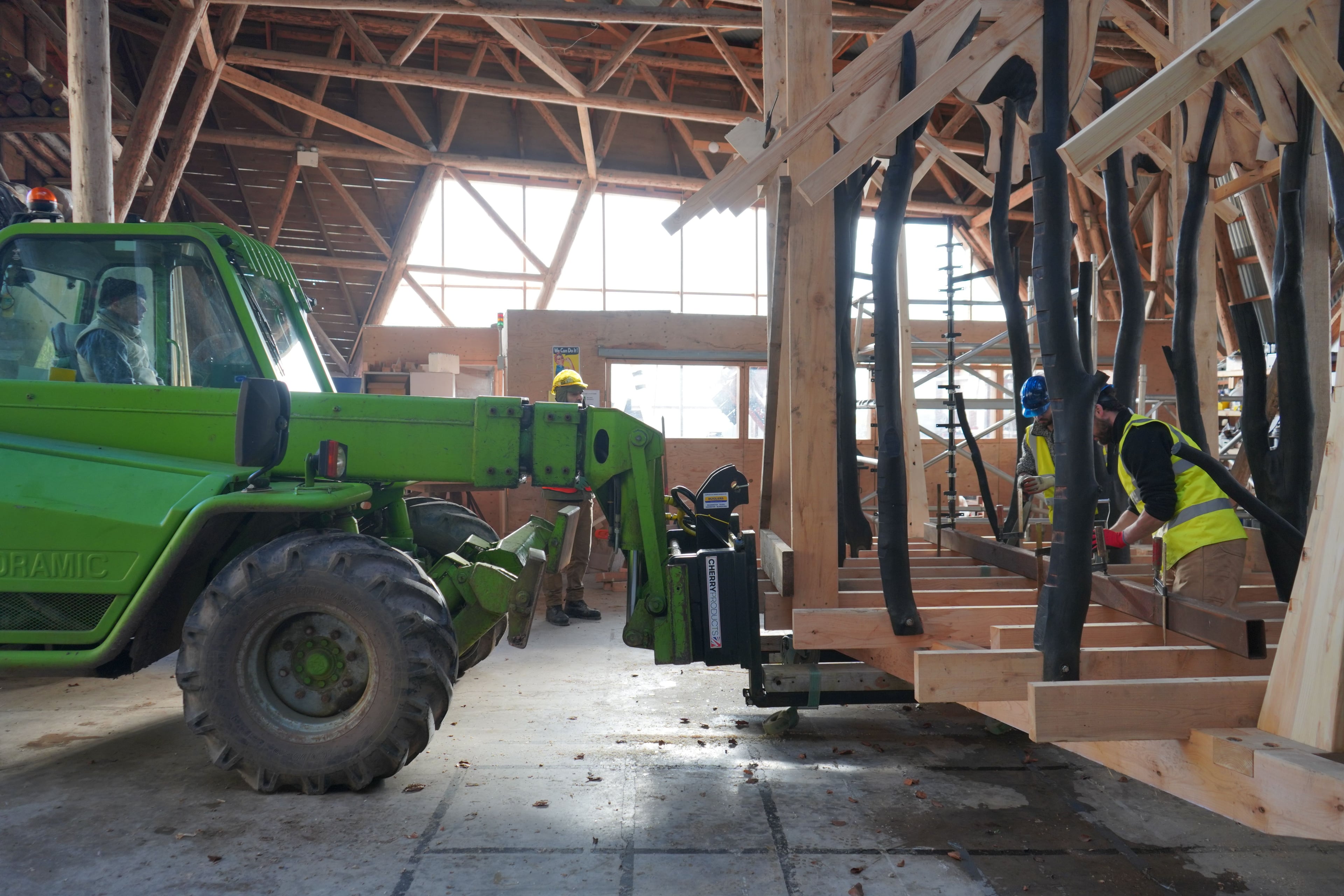
Hooke Park Build is an intensive two-week programme where participants take part in the physical production of experimental architecture at the AA’s Hooke Park campus in Dorset.
Working on active projects, participants are exposed to many aspects of timber building – from forestry operations and traditional building methods to innovative robotic fabrication – all while inhabiting an idyllic forest setting.
In addition to supervised participation in building activities, participants will be introduced to fundamental tools through a selection of taught sessions, ranging from 3D scanning to the use of hand tools and computer-controlled production tools. This year we will also engage with Wild Clay sourced from the forest and provide an aluminium casting session.
Prominent Features of the workshop/ skills developed:
Additional Information
Work Week: Participants will work and be supervised on fabrication and construction activities. Each session starts with mandatory safe working inductions.
Meals on Site: Hooke Park's Refectory The meals are now exclusively vegetarian. Please advise us of any allergies or dietary requirements. Additionally, participants have access to a fully equipped kitchen for non-catered meals.
Accommodation: Participants live on site in Westminster Lodge, a dormitory with shared same-sex twin rooms, each with en-suite washroom and shower pods.
Accommodation and Food: All fees for this programme include shared accommodation at Hooke Park and meals [breakfast/lunch /dinner] . If you are local to Hooke Park and do not require accommodation and/or meals, please contact the Visiting School Office.
All making material included.
Participants need to bring their own laptops and drawing tools.
Flights are not included.
APPLICATIONS TO THIS PROGRAMME ARE NOW CLOSED
Hooke Park Build is open to applicants from all backgrounds – we seek interesting and interested people.
ENTERING THE UK
If you are traveling to the UK from abroad, it is your responsibility to ensure that you hold the right documents to enter the UK.
All applicants are required to review the relevant sections on ‘Entering the UK’ via the UK Government website to check which documents are required to enter the UK and check if an application to a Standard Visitor visa or an Electronic Travel Authorisation (ETA) is needed. Your type of immigration document and how to apply depends on your nationality, the AA can provide a letter confirming your enrolment to the course to support your application once the course fees are settled.
Electronic Travel Authorisation (ETA)
Commencing 8 January 2025, the UK introduced ETAs for all visitors who do not currently need a visa for short stays of under six months, including Australian, Canadian, and US passport holders.
Starting in April 2025, all visitors to the UK who do not require a visa for short stays and do not already have a UK immigration status will need an Electronic Travel Authorisation (ETA). This includes nationals from many countries, including those in the European Union as well as Bahrain, Kuwait, Oman, Qatar, Saudi Arabia, and the United Arab Emirates, among others.
You can Check if you can apply for an ETA on the UK Government website. An ETA costs £10 and allows multiple entries into the UK for stays of up to six months at a time, valid for two years or until the holder’s passport expires—whichever is sooner.
Standard Visitor Visa
Please note that Standard Visitor Visas may take up to 3 months to be issued, all applicants who require a visa to enter the UK are encouraged to apply for a Standard Visitor visa at least 3 months in advance and no later than 1 month before the start of the programme or the date of the flight in which is intended to enter the UK, whichever is first. Student Visas are not required for study periods shorter than six months.
How to apply for a Standard Visitor Visa depends on your country of origin. You can check check if you need to apply for a visa in advance or if you can enter with and ETA and your passport upon arrival in the UK.
Applicants who need a visa to study in the UK are encouraged to carefully review the details and eligibility criteria for the Standard Visitor Visa, which are available on the UK Government website. The Visiting School Office will provide guidance throughout the process to ensure applicants are well-informed and prepared to submit their visa applications. Please also review the costs associated with obtaining a visa.
Once an applicant has been accepted into the programme and has paid the deposit or full fees (see ‘Fees’ section), the Visiting School Office will issue an invitation letter confirming enrolment. This letter can also be used as a supporting document when entering the UK.
All participants are responsible for their own insurance including travel and health insurance. All participants also need to ensure that any equipment and valuable items such as laptops are covered by their own insurance as the AA takes no responsibility for items lost or stolen.
For students from the European Union
If you are a student from another country in the European Union, here for less than six months, you will require a European Health Insurance Card (EHIC, previously called E111) which must be obtained from your home country. The card is not an alternative to travel insurance. It will not cover any private medical healthcare or costs, such as mountain rescue in ski resorts, being flown back to your home country, or lost or stolen property. Therefore it is important to have both an EHIC and a valid private travel insurance policy. Some insurers now insist that you hold an EHIC, and many will waive the excess if you have one.
For students from non-European Union countries, ie international students
If you are here for less than six months, please note you are not covered for National Health Service treatment in the UK. You are therefore required to obtain travel/health insurance from your own country.
Programme Head:
Emmanuel Vercruysse is a Co-Director of Design + Make at the AA. He is a designer with a deep interest in the relationship between drawing and making. He holds a BSc, Diploma and Masters degree from the Bartlett school of Architecture, having previously studied furniture design in Belgium, and approaches design as a series of translations between drawings and objects that oscillate between intuitive acts and precise operations. This approach to design combined with his in-depth knowledge of digital fabrication techniques means that he views the digital very much as an augmentation of the poetic capacity of the analogue and he continues to explore the production of architecture intuitively through iterations of drawing, prototyping, craft and code. Emmanuel is involved in numerous collaborative practices and research groups, including art and architecture practice LiquidFactory; Field Robotics group RAVEN and the RIBA award winning experimental architectural practice Sixteen*(makers).He has held a set of leading roles at the Architectural Association and the Bartlett School of Architecture. As well as being Co-Director of the AA Postgraduate Design + Make course – positioning the campus at the forefront of Architectural Research through prototyping and large scale fabrication – he was Programme Director of the Design for Manufacturing course at the Bartlett’s Here East campus.