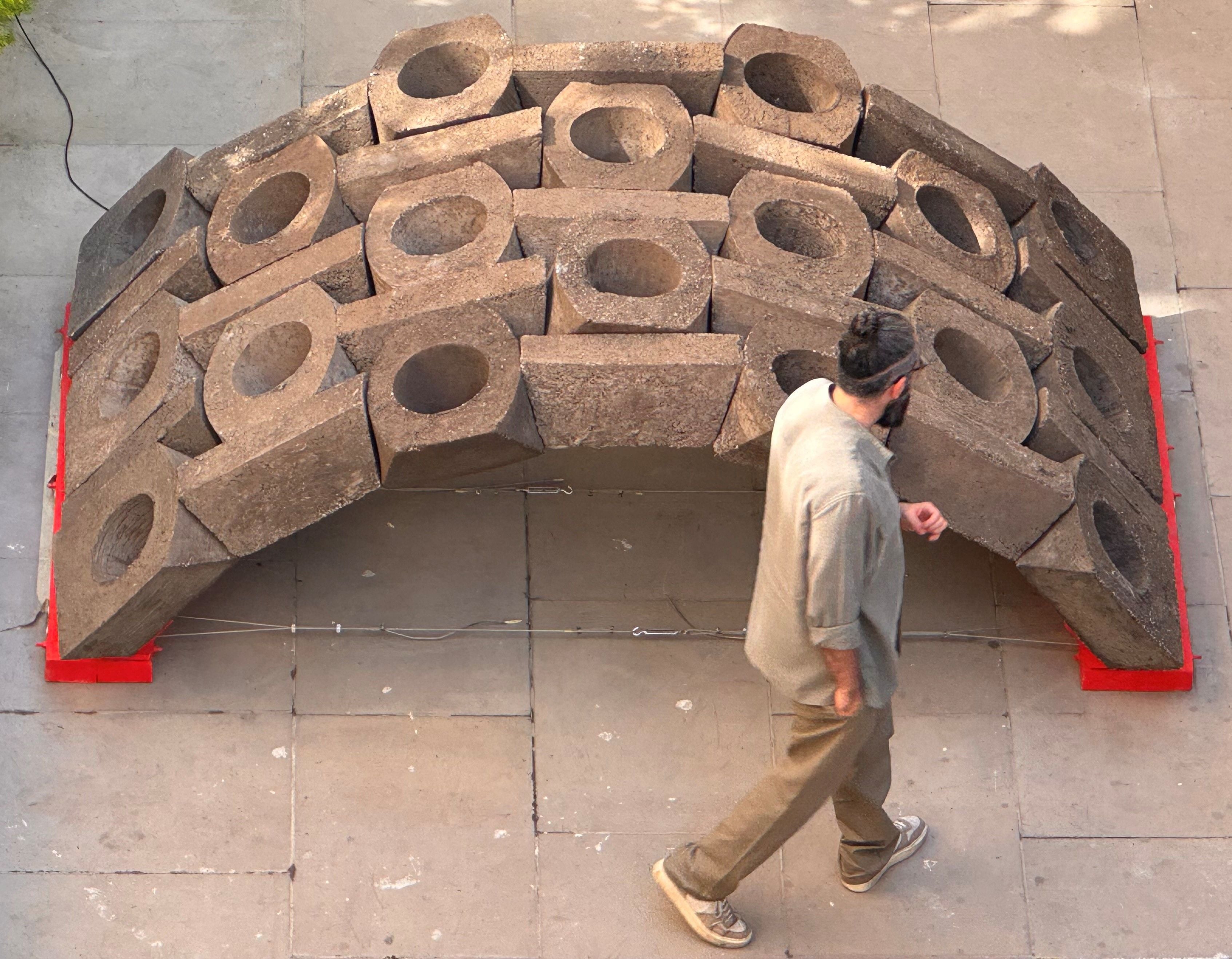
Celebrating its 20th year in 2025, the flagship Visiting School DLAB returned to launch an exciting new agenda: Robotic 3D Printing.
For three-weeks at the AA London Headquarters, participants explore innovative fabrication techniques and gain hands-on experience at the forefront of architectural technology.
DLAB experiments with the integration of advanced computational design, analysis, and large-scale prototyping techniques. The programme builds on its expertise in complex architectural design and fabrication processes, with a strong emphasis on materiality and performance. DLAB brings together a diverse group of experts — tutors and lecturers — from internationally renowned academic institutions and practices, including the Architectural Association, Zaha Hadid Architects, and others.
The research generated at DLAB has been widely published in international media outlets such as ArchDaily, Archinect, and Bustler, as well as in peer-reviewed conference papers, including SimAUD (Simulation for Architecture and Urban Design), eCAADe (Education and Research in Computer-Aided Architectural Design in Europe) and DMS (Design Modelling Symposium).
In 2026, AA DLAB will explore the intersection of sustainability, material reuse, and advanced fabrication by focusing on the integration of robotic 3D printing and the upcycling of materials. The objective is to use 3D printing innovatively to bridge the gaps between found materials, transforming them into cohesive architectural structures. The research agenda emphasizes reducing material waste by incorporating discarded or locally sourced elements into the design process. By leveraging the precision and adaptability of 3D printing, the research aims to demonstrate how advanced technologies can advance sustainable practices in the creation of environmentally conscious structures.
The programme enriches the academic experience with a series of expert-led lectures and industry visits, providing students with valuable insights into the architectural profession. Previous lectures have featured renowned practices such as Grimshaw Global, Foster + Partners, PLP Labs, Mamou-Mani Architects, AKT II, Buro Happold Engineering, Zaha Hadid Architects, and TU Delft. Student life at DLAB is active and engaging, supported by its London base, which offers access to one of the most dynamic architectural hubs in the world. Participants benefit from the city’s vibrant architectural scene, including office visits to leading firms and exposure to cutting-edge practices.
PROGRAMME STRUCTURE:
PART 1 – Participants are introduced to core concepts of material processes, computational methods and digital fabrication techniques. Basic and advanced tutorials on computational design and analysis tools are provided. The programme performs as a team-based workshop promoting collaboration, research and ‘learning-by-experimentation’.
PART 2 – Participants propose design interventions based on the skills and knowledge gained during phase 1 and supported by scaled study models and prototypes. The fabrication and assembly of a full-scale architectural intervention with the use of robotic fabrication techniques will then unify the design goals of the programme.
PROMINENT FEATURES OF THE WORKSHOP/ SKILLS DEVELOPED
For more information about the programme and the repository of previous years’ works, please visit DLAB's own page here.
Fees do not include flights or accommodation, but accommodation options can be advised.
All making materials included.
Students need to bring their own laptops, and drawing tools.
By submitting an application to the programme, participants confirm that they have read, understood, and agreed to the AA Visiting School Terms and Conditions.
A small number of places are available for this programme, we advise you to secure your place as soon as possible by completing the online application which includes a £60 deposit fee and subsequently, by making full payment of the fees. Please note that a deposit payment holds your place onto the course but does not confirm it.
1. Standard Application:
2. AA Students and Melbourne University Students.
4. Group or Architectural practice applications.
Note: Check the step-by step guide to navigate the AA Applicant's portal.
ACCOMMODATION
The AA recognises that the prospect of finding private-sector housing* upon arrival to London can be daunting, and has therefore enlisted the services of the University of London Housing Services (ULHS). The ULHS offers advice to students regarding how to find accommodation, which areas to consider, pricing, contract checking, legal advice and more. They produce an annual Private Housing Guide and maintain an online database of available accommodation provided by registered landlords and letting agents for both groups and individuals. The ULHS also works with short-term accommodation providers and Private Student Halls of Residences.
Applicants can book an appointment for advice. You will need to provide ULHS with a copy of your unconditional offer letter from the AA.
*Please remember to check the council tax exemption criteria specific to each borough when taking out your accommodation. The AA can provide a letter confirming that you are a participant on the Summer School programme but cannot guarantee council tax exemption.
The workshop is open to current architecture and design students, PhD candidates, young professionals and architecture or engineering practices who are interested in upskilling their fabrication techniques.
Software Requirements: Adobe Creative Suite, Rhino 7. No prior knowledge of software tools is required for eligibility. A CV or a portfolio is only required for scholarships applications.
ENTERING THE UK
If you are traveling to the UK from abroad, it is your responsibility to ensure that you hold the right documents to enter the UK.
All applicants are required to review the relevant sections on ‘Entering the UK’ via the UK Government website to check which documents are required to enter the UK and check if an application to a Standard Visitor visa or an Electronic Travel Authorisation (ETA) is needed. Your type of immigration document and how to apply depends on your nationality, the AA can provide a letter confirming your enrolment to the course to support your application once the course fees are settled.
Electronic Travel Authorisation (ETA)
All visitors to the UK who do not require a visa for short stays and do not already have a UK immigration status will need an Electronic Travel Authorisation (ETA). This includes nationals from many countries, including those in the European Union as well as Bahrain, Kuwait, Oman, Qatar, Saudi Arabia, and the United Arab Emirates, among others.
You can Check if you can apply for an ETA on the UK Government website. An ETA costs £10 and allows multiple entries into the UK for stays of up to six months at a time, valid for two years or until the holder’s passport expires—whichever is sooner.
Standard Visitor Visa
Please note that Standard Visitor Visas may take up to 3 months to be issued, all applicants who require a visa to enter the UK are encouraged to apply for a Standard Visitor visa at least 3 months in advance and no later than 1 month before the start of the programme or the date of the flight in which is intended to enter the UK, whichever is first. Student Visas are not required for study periods shorter than six months.
How to apply for a Standard Visitor Visa depends on your country of origin. You can check check if you need to apply for a visa in advance or if you can enter with and ETA and your passport upon arrival in the UK.
Applicants who need a visa to study in the UK are encouraged to carefully review the details and eligibility criteria for the Standard Visitor Visa, which are available on the UK Government website. The Visiting School Office will provide guidance throughout the process to ensure applicants are well-informed and prepared to submit their visa applications. Please also review the costs associated with obtaining a visa.
Once an applicant has been accepted into the programme and has paid the full fees (see ‘Fees’ section), the Visiting School Office will issue an invitation letter confirming enrolment. This letter can also be used as a supporting document when entering the UK.
All applicants are responsible for securing their own travel and health insurance and should ensure that their policy provides coverage for personal belongings such as laptops, equipment, tools, passports, etc. The AA takes no responsibility for lost or stolen property.
Note for EU, EEA, and Swiss Citizens:
The UK left the European Union on 31 January 2020. Applicants should complete the Brexit checker and review the guidance notes on healthcare for visitors to the UK from the EU.
Applicants who are in the UK for less than six months will require a European Health Insurance Card (EHIC), which can be obtained from their home country. This card is not an alternative to travel insurance and will not cover any private medical healthcare costs or lost or stolen property. It is therefore important to have both an EHIC and a valid private travel insurance policy.
Note for international students:
As you will be in the UK for less than six months, you are not covered for National Health Service (NHS) services and treatment, and must therefore obtain travel and health insurance from your own country.
BIOGRAPHY
Dr. Milad Showkatbakhsh is an accomplished architect, educator, and researcher specializing in computational design and emergent technologies. He is the Co-Director of the Emergent Technologies and Design program (EmTech) at the Architectural Association (AA) and the Co-Director of the AA DLAB and AA Istanbul Visiting School. As co-founder of Wallacei, a multi-objective optimization engine for Grasshopper 3D, he empowers designers with advanced generative and machine learning tools. Milad's work integrates biological intelligence principles into architecture, redefining adaptive environments using computational methodologies. He holds a bachelor’s degree in architectural engineering from Shahid Beheshti University and a master’s in architecture from Pratt Institute, where he received the Sidney Katz Award in 2015. His PhD at the AA focused on evolutionary models for urban morphologies with homeostatic behaviours.